
Cost to Hire Security for Business: Hourly and Daily Rates
The cost to hire security for a business typically falls between £21 and £26 per hour on the UK market. But the lowest hourly rate won’t necessarily suit your site or provide the cover you need.
It’s sensible to set a budget before arranging business security. The cost to hire security for a business depends on the hours, duties and level of cover required, so an hourly rate alone does not show the full picture.
This guide explains typical hourly and daily rates, how continuous cover affects costs, and what to consider when assessing your business’s security needs. You’ll be better placed to match the protection to your premises, operating hours and risks.
Key Takeaways
- Compare hourly and daily quotes against the exact cover period and duties, not just the headline rate.
- Continuous guarding requires shift cover, so assess the full staffing requirement when planning a budget.
- Guard experience and relevant training can affect the rate; match the level of expertise to your site’s needs.
- Map your site’s risks, operating hours and vulnerable areas to identify the right type and level of security.
24/7 Manned guarding: what does continuous cover cost?
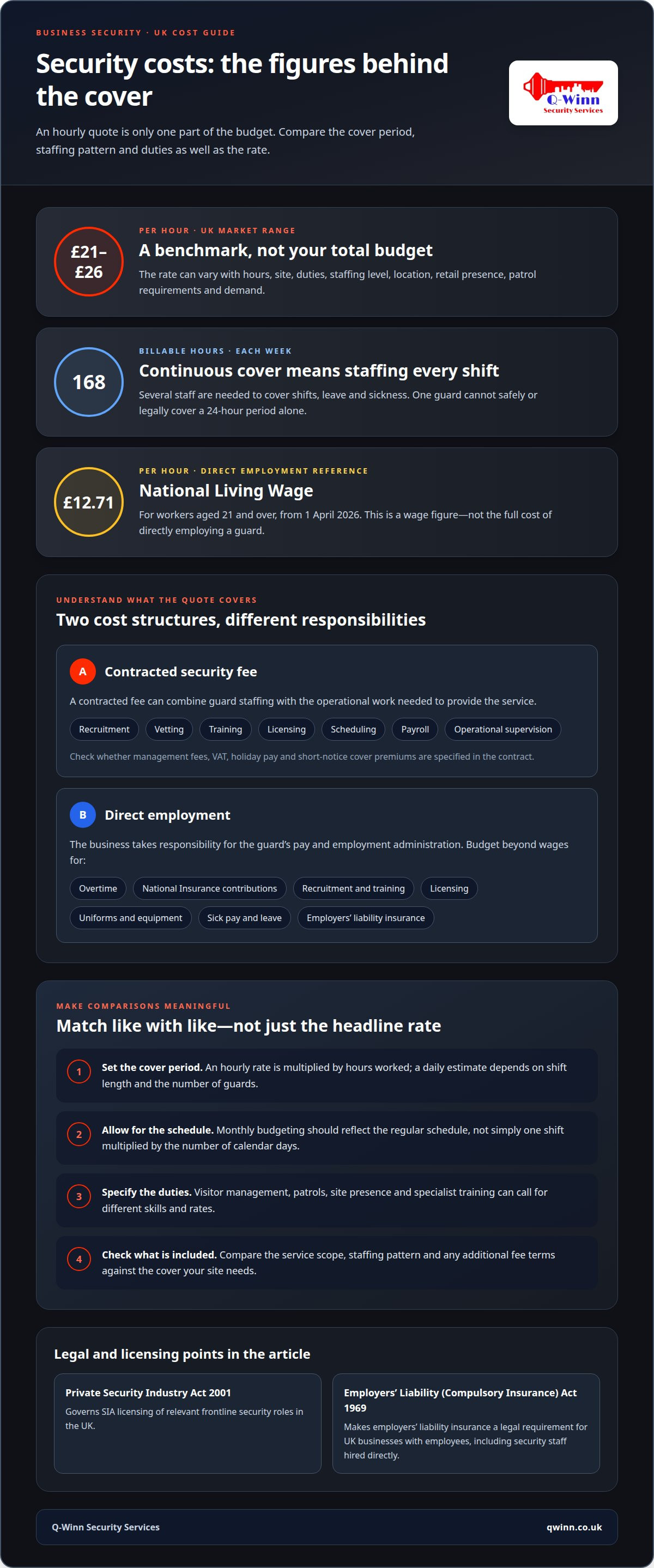
Continuous cover means staffing a security post across every shift, rather than hiring a guard for selected hours. A UK market range is £21 to £26 per hour, but total spend depends on the cover pattern and employment structure.
Factors shaping security pricing
Security pricing reflects the hours, site, duties and staffing level required. The UK market range of £21 to £26 per hour gives a reference point, not a total budget. Retail presence, patrol requirements, location and demand can all affect the rate. Continuous cover means 168 billable hours per week, with several staff needed to cover shifts, leave and sickness.
Costs within contracted security fees
A contracted fee can combine guard staffing with recruitment, vetting, training, licensing, scheduling, payroll and operational supervision. The Private Security Industry Act 2001 governs SIA licensing of relevant frontline security roles in the UK, according to The National Archives. Contract terms may also set out management fees, VAT, holiday pay and any premium for short-notice cover. Knowing what the fee includes helps compare the service structure with the site’s monitoring needs.
Direct employment costs
Direct employment means the business takes responsibility for the guard’s pay and employment administration. The UK National Living Wage for workers aged 21 and over is £12.71 per hour from 1 April 2026, according to the UK Government. Other costs include overtime, National Insurance contributions, recruitment, training, licensing, uniforms, equipment, sick pay and leave. The Employers' Liability (Compulsory Insurance) Act 1969 makes employers' liability insurance a legal requirement for UK businesses with employees, including security staff hired directly, according to The National Archives. These obligations affect the full hiring budget, beyond wages alone.
Hourly, daily and monthly cost structures
An hourly rate is multiplied by the hours worked; a daily estimate depends on the shift length and staffing required. Monthly budgeting should account for the regular schedule, not simply one shift multiplied by the number of calendar days. For 24/7 cover, calculate from 168 billable hours per week, then allow for staff rotation. One guard cannot safely or legally cover a 24-hour period alone. This distinction helps businesses compare limited presence with a continuous guarding requirement.
What are the average hourly and daily rates for hiring a security guard?
UK rates vary by assignment, training and location. Use the figures below as market benchmarks, then assess the duties and site coverage your business needs.
Guard experience and training
Experience and role-specific training can affect a security guard’s rate. A trained guard managing visitor access at a corporate reception has different duties from someone watching a construction site overnight. More extensive experience or specialist training may increase the guard cost, so match the required skills to the risks at your premises. This helps you focus the budget on relevant expertise rather than unnecessary duties.
Typical UK hourly and daily rates
A daily rate depends on shift length and the number of guards, so compare quotes for equivalent hours and responsibilities. Key Holding & Alarm Response provides a different coverage model from an officer stationed on site.
London hourly rates
London figures are a regional comparison, not a Bracknell rate. Layout affects staffing: multiple entrances or separated buildings may require more guards. Compare the proposed coverage with the areas that need a visible presence.
To consider coverage options for your premises, explore business security support.
Assessing business security requirements
Start by assessing risks at your premises, then match services to specific concerns. Map entrances, loading areas, public access points and locations holding valuable stock or equipment. A retail unit may need a visible presence near the shop floor, while a warehouse may prioritise overnight protection. This assessment gives the security plan a clear purpose.
Next, record when risks arise and who needs protection. Compare opening hours, deliveries, staff departures and quiet periods; note where personnel or visitors could be vulnerable. If a site faces higher exposure after closing, continuous guarding may be more relevant than daytime presence. If concerns centre on opening and closing routines, Lock-Up & Unlock Services may address that specific part of the schedule.
Site layout also shapes the plan. A single entrance and compact floor area call for different coverage from several buildings, blind spots or separate public and staff entrances. Identify which areas need monitoring and whether a uniformed presence would help. Then define the required duties, such as visitor management, patrols or safeguarding equipment. The aim is proportionate cover, not simply more personnel.
Finally, use the assessment to compare service scope and the hourly rate against actual operating needs. Separate essential tasks from occasional requirements, such as extra coverage during deliveries or overnight periods. This makes it easier to see whether static guarding, scheduled lock-up support or a combination fits the premises. Discuss security for your premises to connect the identified risks with a practical guarding arrangement.
Q-Winn Security: Key Holding & Alarm Response
Q-Winn Security provides Key Holding & Alarm Response for businesses that need an arranged response when an alarm activates. It can suit premises where employees should not have to attend alarm call-outs, or where security needs extend beyond staffed opening hours.
Choose the service according to the risks and tasks at your site. Mobile Patrol provides scheduled and random checks, while Static / Manned Guarding places an SIA-trained officer on site. Lock-Up & Unlock Services support opening and closing routines. Each addresses a different requirement, so match the arrangement to your operating hours and security priorities.
For a practical discussion about your premises and the cover you need, contact Q-Winn Security or visit qwinn.co.uk.
Turn your security priorities into a clear plan
When assessing the cost to hire security for a business, prepare a clear brief: identify the areas needing attention, when cover matters most and the tasks officers should perform. This gives your security discussions a practical foundation and helps distinguish essential protection from measures that do not match your premises or daily operations.
Q-Winn Security offers Key Holding & Alarm Response, Mobile Patrol and Lock-Up & Unlock Services. These address different needs, from alarm response to scheduled and random checks and support with opening or closing a site. Set out your priorities, then consider which arrangement fits the way your business operates.
Contact Q-Winn Security to discuss your premises and next steps. A considered plan can help you move forward with greater clarity and confidence.
Frequently Asked Questions
How much does it cost to hire a security guard?
There is no single fixed amount for every assignment. The cost to hire security for a business depends on the hours, duties and cover required. Q-Winn Security provides pricing through a free quote or on request. When comparing proposals, use the same shift length and responsibilities, and check whether VAT is included.
Should I hire an in-house security team or outsource to a contract company?
Outsourcing can suit businesses that need security cover without managing recruitment and shift rotas themselves. Direct employment may fit a site with stable, ongoing duties and the internal capacity to manage staff. Consider whether your requirements change over time or remain consistent, and choose an arrangement that fits your operations.
What legal and insurance obligations do I have as an employer hiring security staff?
If you employ security staff directly, the Employers' Liability (Compulsory Insurance) Act 1969 makes employers' liability insurance a legal requirement for UK businesses with employees, according to The National Archives. Direct employers also manage the employment relationship, including payroll, leave and staff supervision. Include these responsibilities in your planning, alongside the guard’s duties and the arrangements for absence cover.
What type of security does my business actually need?
Choose a service based on the risk and task. A Bracknell business concerned about unattended alarm activations may consider Key Holding & Alarm Response; a site needing visible checks may consider Mobile Patrol. Lock-Up & Unlock Services can suit premises needing support with opening or closing routines. Match each requirement to the part of your operation it protects.
Do I legally need an SIA-licensed guard, or can anyone do the job?
Relevant frontline security roles require attention to SIA licensing. The Private Security Industry Act 2001 governs SIA licensing of relevant frontline security roles in the UK, according to The National Archives. Whether a licence applies depends on the role’s duties, not simply its job title. Define what the person will do, especially where their work involves guarding or protecting people and premises.
Frequently Asked Questions
There is no single fixed amount for every assignment. The cost to hire security for a business depends on the hours, duties and cover required. Q-Winn Security provides pricing through a free quote or on request. When comparing proposals, use the same shift length and responsibilities, and check whether VAT is included.
Outsourcing can suit businesses that need security cover without managing recruitment and shift rotas themselves. Direct employment may fit a site with stable, ongoing duties and the internal capacity to manage staff. Consider whether your requirements change over time or remain consistent, and choose an arrangement that fits your operations.
If you employ security staff directly, the Employers' Liability (Compulsory Insurance) Act 1969 makes employers' liability insurance a legal requirement for UK businesses with employees, according to The National Archives. Direct employers also manage the employment relationship, including payroll, leave and staff supervision. Include these responsibilities in your planning, alongside the guard’s duties and the arrangements for absence cover.
Choose a service based on the risk and task. A Bracknell business concerned about unattended alarm activations may consider Key Holding & Alarm Response; a site needing visible checks may consider Mobile Patrol. Lock-Up & Unlock Services can suit premises needing support with opening or closing routines. Match each requirement to the part of your operation it protects.
Relevant frontline security roles require attention to SIA licensing. The Private Security Industry Act 2001 governs SIA licensing of relevant frontline security roles in the UK, according to The National Archives. Whether a licence applies depends on the role’s duties, not simply its job title. Define what the person will do, especially where their work involves guarding or protecting people and premises.